Please fill in the form below and we will get back to you.
Alternatively email us at info@dbrlimited.com or for urgent enquiries call us on 020 7277 7775.
In 1865, the Crystal Palace Subway was carved beneath the city as a ceremonial threshold a grand, subterranean gateway leading first-class passengers toward the High-Level Station and the wonder of the Crystal Palace beyond. Rich in Victorian ambition, it was never meant to be hidden or forgotten.
That story fractured in 1936, when fire tore through the High-Level Station and parts of the Subway itself. What followed was not renewal, but silence. For decades and most recently for over ten years the site lay abandoned, buried beneath uneven ground and fading memory.
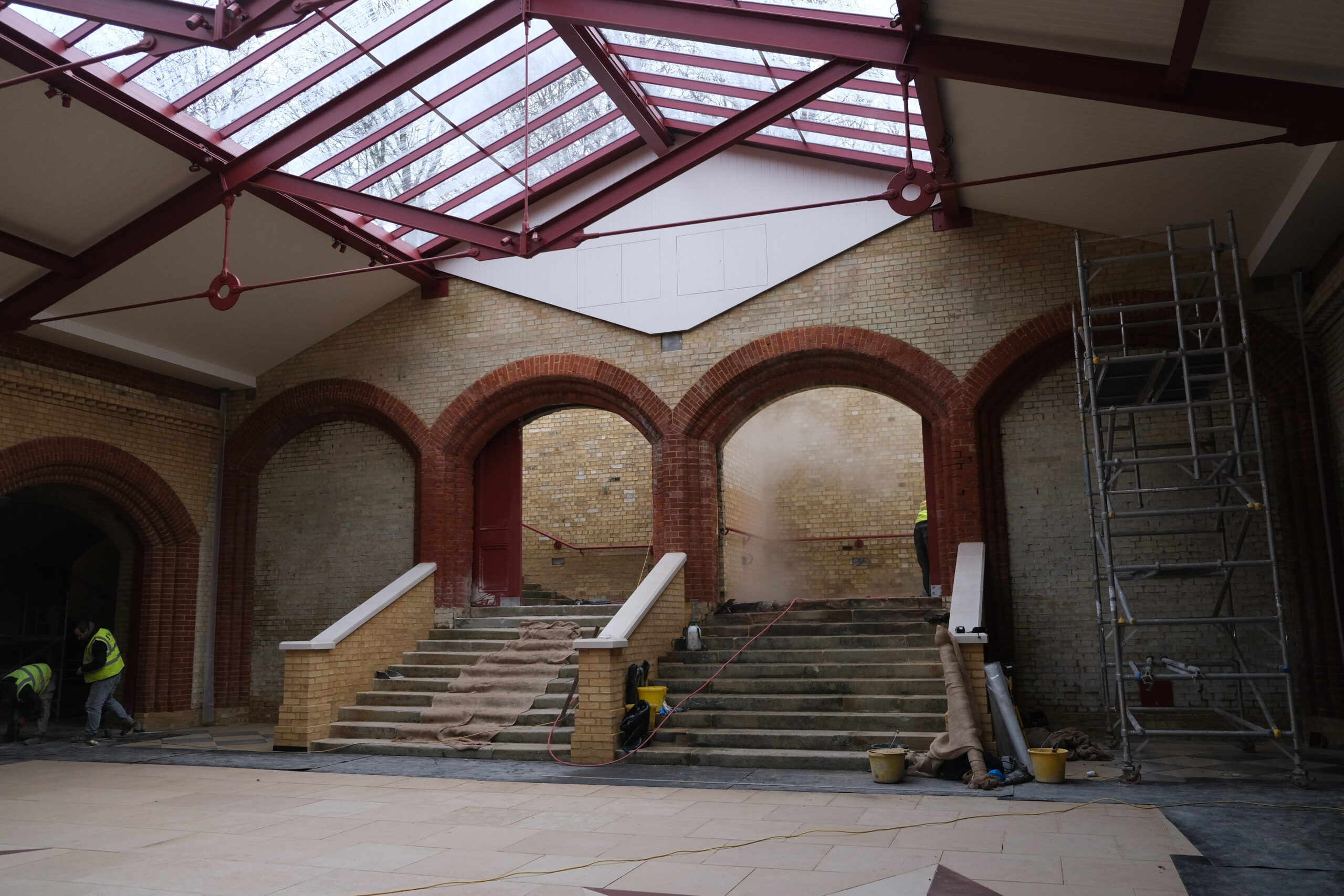
DBR London’s skilled stonemasons and bricklayers arrived not to overwrite history, but to uncover it. Excavation revealed long-hidden floor patterns and original stonework, including slabs from the north and south staircases, carefully lifted, repurposed, and returned to their place. Brick colours were matched by eye and experience; mortars were analysed and recreated to echo the original Victorian fabric.
Many of the original stones could no longer be quarried. New materials were therefore sourced and matched for colour, strength, and character, ensuring continuity where exact replication was no longer possible. Each decision balanced authenticity with longevity
To enable new reinforced concrete footings, historic stone staircases were delicately lifted and temporarily dismantled. Excavation took place between flanking masonry walls, some of which subterranean and weakened by time, had to be carefully taken down, stored, and later rebuilt. New retaining walls were constructed before the historic masonry and staircases were reinstated, almost invisibly returning strength beneath the surface.
Years of collapse had left the ground uneven and unstable. More than 750 square metres of ground were regraded to restore level access to the historic Subway. Around 100 square metres of paving were lifted, new substrates and Type 1 footings installed, and the paving re-laid each operation carried out with constant awareness of the fragile historic fabric nearby.
The 1936 fire had stripped the Subway of all services. DBR undertook extensive contractor-designed MEP works to bring the site back to life. Drainage investigations traced historic pipe runs through ground-penetrating surveys, followed by careful excavation, repair, lining, replacement, and the introduction of new pipework. Power was reintroduced via a 300-metre ducting route along Crystal Palace Parade, reconnecting the buried structure to the modern city above.
The East Courtyard roof was replaced with a new dual-pitched structure, complete with all-new glazing. Alongside this, service installations were improved, allowing light, function, and purpose to return to spaces that had long been dark.
What emerged was not simply a restored structure, but a recovered journey. The Crystal Palace Subway once again revealed its scale, craft, and intent a Victorian passage brought back from abandonment through patience, skill, and deep respect for the past.